
Pharmacy debts and collections: the ledger the sales rep has to keep alone
In many markets the rep does not only promote. They sell to the pharmacy or the clinic, deliver or arrange delivery, and come back for the money. From that moment every open invoice is the rep's problem — and the company's ledger, if there is one, is not written from the rep's side.
Why collections land on the rep
The company sees a receivable. The rep sees a pharmacist who paid half in cash, promised the rest "after the weekend", returned two boxes of the expired batch, and now disputes the total. The company's accounting system will record the invoice and, eventually, the payment. It will not record the half-payment, the promise, the return or the dispute — and those are exactly the four things the rep needs on the next visit.
So the rep keeps a ledger. Usually it is a notebook page per pharmacy, sometimes a spreadsheet, occasionally a WhatsApp thread with the pharmacist that doubles as the record. It works until the page is lost, the sheet is on the laptop at home, or the pharmacist says "you never told me about that invoice".
A ledger you can defend
A collections ledger has one job: to let you say, at the counter, "here is what was delivered, here is what you paid, here is what is open, and here is how long it has been open" — and to have the pharmacist agree. That takes four columns per clinic, kept in date order:
- Debits — every delivery, with product, quantity, unit price and the tax if it applies, on the date it was delivered.
- Credits — every payment, with the amount and how it was paid, on the date you received it. Partial payments are payments; record them as such.
- Returns — recorded as returns against the original product, not as deleted sales, so the history shows what came back and when.
- A running balance — after every line, so any dispute can be walked back to the last date you both agreed on.
Write the debit when you deliver and the credit when you are handed the money, not at the end of the week. A collections ledger written from memory is the one the pharmacist wins arguments against.
Age the debt, do not just total it
"Pharmacy X owes 4,800" is a fact. "Pharmacy X owes 4,800, of which 3,200 is over sixty days" is a decision. The second number tells you which pharmacies to visit first, which ones to stop delivering to until they pay, and which ones to raise with the manager before the quarter closes. Split every open balance into buckets — current, one to thirty days, thirty-one to sixty, sixty-one to ninety, over ninety — and read the right-hand columns first. The pharmacies in the 90+ column are not going to fix themselves.
The collection round
Once a week, before the round, print or open the aging table and the statement for each pharmacy you will visit. Walk in with the statement. Most disputes end when the pharmacist sees the dated lines: the delivery they forgot, the payment that was recorded, the return that was credited. The ones that do not end there are the ones where your record has a gap, and the aging table shows you which those are before the pharmacist does.
Two habits protect the round. Give a dated receipt line for every payment, even a partial one, and record it on the spot. And when a pharmacy crosses sixty days, stop adding debits until the balance moves — a ledger that keeps growing on a non-paying account is a ledger you will be asked to explain.
Keep the ledger separate from the promotion record — and joined to it
Promotion visits and collection visits are different jobs, but they happen at the same clinics with the same people. Keep the money on the clinic's account — statement, balance, aging — and the visits on the clinic's history, so that opening the clinic shows both. The doctor's feedback last month and the pharmacy's overdue balance this month are part of the same relationship, and the rep who sees both before walking in handles the conversation better than the one who sees only one. The visit side of that record is the subject of The daily call report without the night shift.
Questions reps ask
The company's system already tracks receivables. Why keep my own?
Because the company's ledger is written for accounting, at the company's pace, and it does not carry the partial payments, promises and disputes that happen at the counter. Your ledger is the one you can open in front of the pharmacist. When the two disagree, yours is dated line by line; that is usually enough.
How do I handle VAT on the debit lines?
Record the sale at the unit price and let the tax be applied at the rate your country uses, so the debit on the clinic is the amount actually owed. If you sell tax-inclusive, note that once in the clinic's record so the statement matches the invoice the pharmacist holds.
What if the pharmacist pays a different rep, or pays the distributor directly?
Record the credit with a note of who received it and get the date. Your ledger should reflect what the pharmacy has paid, whoever collected it; otherwise the aging table will send you back to a pharmacy that has already settled.
How far back should the ledger go?
From the first delivery you are responsible for. If you inherited open balances, enter them as one opening debit per pharmacy, dated the day you took over, with a note that says "opening balance from handover". Everything after that is yours, line by line.
How RepVisit Pro helps
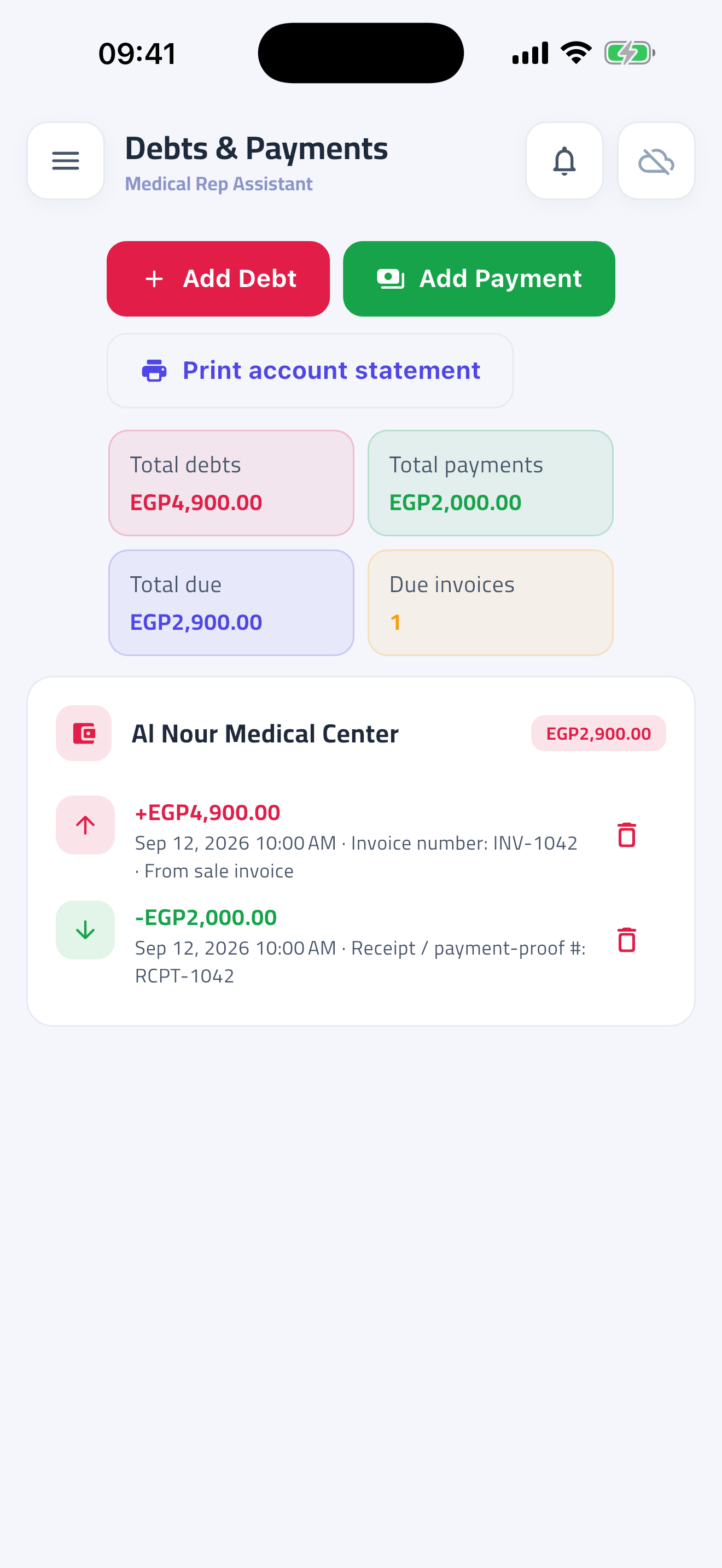
Debts & Payments is the ledger described here: a priced sale recorded inside a visit becomes a debit on the clinic, VAT applied if you set it, a payment becomes a credit, and the running balance follows. Three Reports print what a collection round needs — a per-clinic account statement with the running balance, a debts-and-payments summary with per-clinic balances and the posting journal, and an overdue aging table split into current, 1–30, 31–60, 61–90 and 90+ days. Sales entered as returns net against the balance rather than erasing history. RepVisit Pro keeps the ledger on your phone, and the CSV export of the tabular business records you entered is always available.
Read the guide for this feature