
Hitting the monthly target: know you are behind on the 10th, not the 28th
Every rep knows the target. Far fewer know, on any given Tuesday, how much of it is done. That gap — between the number you owe and the number you can see — is where the last week of the month gets lost.
The target is not one number
Managers talk about "the target" as a single figure, usually in currency. In the field it is never one number. It is a quantity per product: forty boxes of this, twenty tubes of that, twelve vials of the new line the company wants pushed. A rep who is at 110% on the old product and 30% on the new one is not "at 85%"; they are about to have a difficult conversation about the new one.
So the first move is to stop tracking the target as a total and start tracking it per product. Write down, for each product you carry, the quantity owed this month. Most companies keep it constant for months at a time, which is exactly why reps stop writing it down and start assuming — and why the month it changes is the month they miss.
Where the number usually lives, and why that fails
Reporting on the target tends to happen in one of three places. The distributor's monthly sales report, which arrives after the month is over and is by definition too late to act on. The manager's spreadsheet, which the rep sees at the cycle meeting. Or the rep's own notebook, which records visits faithfully and sales rarely, because a sale is a line on an order form, not a line in a notebook.
All three have the same flaw: the number is somewhere else, updated by someone else, on someone else's schedule. Almanassa's reporting on Egyptian reps describes the consequence plainly — the target is not met "in many cases", and the rep faces deductions. Nobody in that story knew on the 10th that the 28th was going to be bad.
Record the sale where it happens
The sale happens at the visit. The doctor agrees to prescribe, the pharmacy next door places an order, the clinic buys a case directly — whichever way your market works, there is a moment when a quantity of a product becomes real, and that moment is at a clinic, not at a desk at 9 pm.
Record it there, as part of closing the visit: product, quantity, unit price if you are the one selling. It takes a moment while the details are in front of you. Done at night from memory it takes longer and is wrong more often than you would like. The rule that makes this work is simple: a visit is not "done" until its outcome is written, and the outcome includes any quantity sold or promised.
Watch achievement as a running total
Once sales are recorded per product as they happen, achievement is just a sum. Forty owed, twenty-six recorded, it is the 14th: you are at 65% with half the month left, which is fine. Twelve owed on the new line, two recorded, same date: that is the product that needs the rest of the month's attention. You knew on the 14th. You can still do something about it.
Two habits keep the running total honest. Enter returns as returns, netted against the product, rather than deleting the original sale — the history should show what really happened. And when the same target repeats next month, let it repeat automatically instead of retyping it, so the one month it changes is the one month you actually touch it.
Split the month across clinics only when it helps
Some reps go a step further and decide how much of each product each clinic should take — a small polyclinic gets ten boxes of the quantity, the big hospital pharmacy gets twenty. That is useful when a few accounts carry most of the volume, because then "behind on product X" becomes "behind at clinic Y", which is something you can drive to. It is noise when volume is spread evenly. Start with the product total; split by clinic only when the top three accounts explain most of the number.
What to show the manager
When the running total lives with you, the cycle-meeting conversation changes. Instead of receiving the number, you bring it: per product, target against achieved, with the completion percentage and the shortfall in units. A one-page printout of that table, dated, is worth more than an hour of explaining. It also makes the deduction conversation a different one — the question becomes "what happened on the new line in week two", which is a question with an answer, rather than "why did you miss", which is not. The daily habit that feeds this table is described in The daily call report without the night shift.
Questions reps ask
My company measures the target in money, not units. Does this still apply?
Yes. Record units and unit price at the visit and the currency total follows. Units are what you can see and count in the clinic; currency is what the report converts them to. Tracking units also keeps you honest when a price changes mid-month.
I do not sell directly — the distributor does. What do I record?
Record what you can attribute to your visit: the prescription commitment, the pharmacy order you saw placed, the quantity the clinic asked for. It will not match the distributor's report to the unit, but it will tell you on the 10th which products are quiet, and that is the point.
How often should I look at the running total?
Once a day, at the end of the day, while closing visits. A mid-month check on the 15th is the minimum. Looking at it hourly does not change anything; not looking at it until the 25th changes everything.
How RepVisit Pro helps
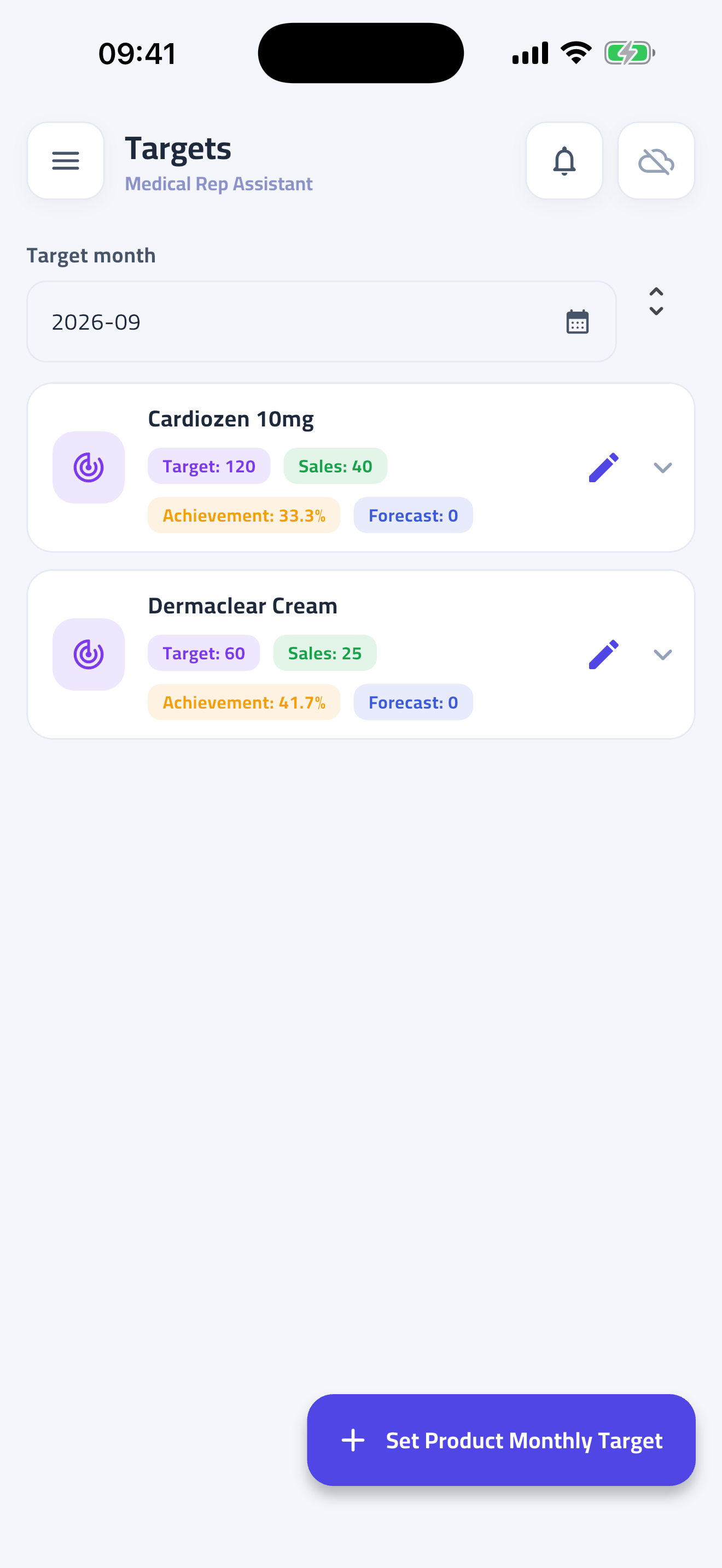
Targets holds one number per product per month, with auto-renew so you do not retype it every 30 days, and the target card shows achieved against target as you record sales. A product target can be split across clinics, the printable Target progress report turns the month into one page, and on the Sales screen returns are netted against achievement instead of erased. RepVisit Pro keeps the whole ledger on your phone.
Read the guide for this feature